| Home
> Diamond
Education > Carat
Carat Weight
The weight of a diamonds is generally given in carats. The term carat originated
in ancient times when gemstones were weighted against the carob bean. Each bean
weighed about one carat. In 1913, carat weight was standardized internationally
and adapted to the metric system. One carat equals 0.2 grams - a little more than
0.007 ounce. In other words, it takes 142 carats to equal 1 ounce. Two
terms, carat and karat are often confused. Karat refers to the fineness of gold
alloys (pure gold is 24 karat; 14 karat is 14 parts gold and 10 parts other metals)
and carat refers to gem weights. The weight of small diamonds is frequently
expressed in points, with one point equaling 0.01 carats. For example, five points
is a short way of saying 5/100 of a carat and fifty points equates to a half carat.
Sometimes in the jewelry trade, the term size is used as a synonym for
carat weight. This is because small round diamonds having the same weight also
look the same size and similar diameters. As diamonds increase in weight, their
size becomes less predictable. Diamonds with a shallow cut can have a greater
diameter than a deeper cut diamond with the same weight. However, you don't want
the diamond to be too shallow or it will not reflect the light properly and will
have less brilliance. Diamond Measurements
It is similar to asking how tall a 200 pound man is. You have no way of knowing
because you don't know how the man is proportioned. The same holds true for diamonds.
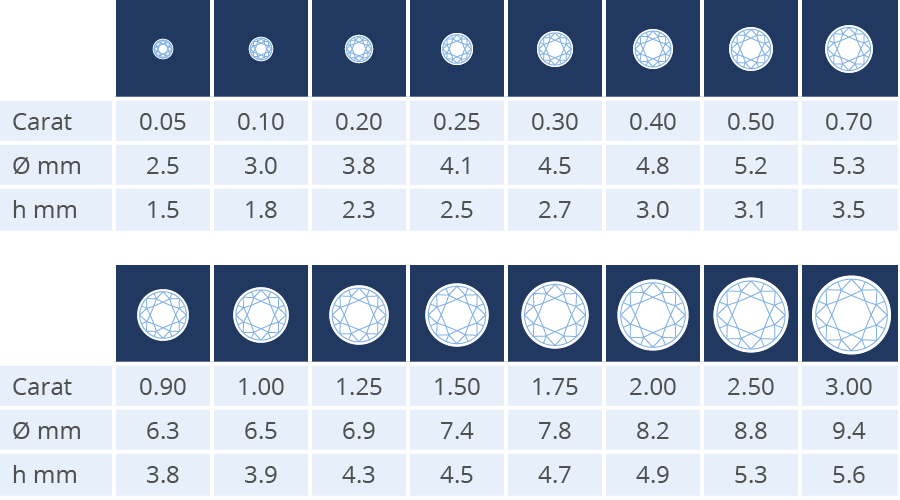
So if size is important to you, focus on diamond measurements as opposed to carat
weight. You don't need to carry a millimeter gauge when you go shopping. Just
start asking what the different millimeter measurements are and note how they
look. Diamonds that look big for their weight may have reduced brilliance and
fire so always insist on great cut. Note that an increase in carat weight
does not produce the same increase in millimeter diameter. For example, there
is a 25% increase in carat weight from 1.00 carats to 1.25 carats but less than
8% increase in diameter (6.5 to 7.0 mm). This concept, along with the increased
price per carat, explains why prices increase dramatically in order to get noticeably
bigger millimeter size. Please have a look at the figure below to see the carat
weight of a diamond and diamater in mm.  Back
to top--^ Carat Price
The weight of a diamond has a large impact on price. All other factors being equal,
the heavier the diamond, the greater its cost will be. Diamonds lose approximately
40-60% of their rough weight when they are cut. Over 1 million rough diamonds
must be mined before one is found that can be cut into a 1.00 carat finished diamond!
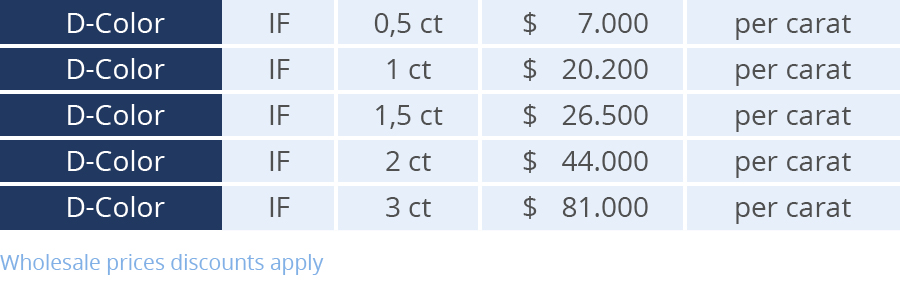
Please have a look at the figure below to get an impression of price increasement
based on carat. Have a look at our Diamond
Education - Cost page to learn more about cost on diamonds.
With each weight category increase (quarter, third, half), the value per carat
of a diamond will increase significantly and almost geometrically (given all have
the same other factors). A stone which is twice as large as an otherwise identical
smaller stone might be three or more times more expensive. So while you might
see a price for a smaller stone at $2,000 per carat, as you price the same cut,
color and clarity in a larger stone you'll see dramatic increases. There
are standards for reporting a diamond's weight. FTC guidelines allow a one-half
point (1/2) tolerance in the stated weight of a diamond. For example, a diamond
weighing .495 carat can be legally sold as a 50 point diamond, while a .494 carat
diamond must be sold as a 49 point stone. Some stores sell diamonds according
to size ranges so you need to insist on knowing the exact weight of your loose
diamond. Advice: Look for diamonds that have a diameter measurement that
is at least as large as the average for that weight. In other words, don't pay
for weight you can't see. If you did not find your Diamond answer here,
please have a look at our Diamond
Tutorial. Back
to top--^ |