


Diamond Color
The whiter, the better
Diamonds are found in a variety of colors, but chances are all the diamonds you’ll see in your shopping will be white or yellow, and the whiter the better. The yellow color in diamonds comes from trace amounts of nitrogen. One part in a million will cause a yellow tint to appear in the K color diamond. As a rule, the more yellow the stone, the less value it has. There’s a good reason for this. The yellower the stone, the less sharp and sparkly it appears. A whiter stone lets greater amounts of light pass through it, making it sparkle and shine.
The exception to the rule is the Fancy Yellow (canary) diamond, which is beautiful bright yellow and priced similar to white diamonds. There are four color grades of Fancy Yellow (Fancy Light Yellow, Fancy Yellow, Fancy Intense Yellow and Fancy Vivid Yellow) with each deeper shade bringing a higher price. We discuss colored diamonds in more detail on the web page we have dedicated to that topic.
Keep in mind that the color illustrated on these color charts is exaggerated in order to see the difference on your computer monitor. Actual color differences are much more subtle.
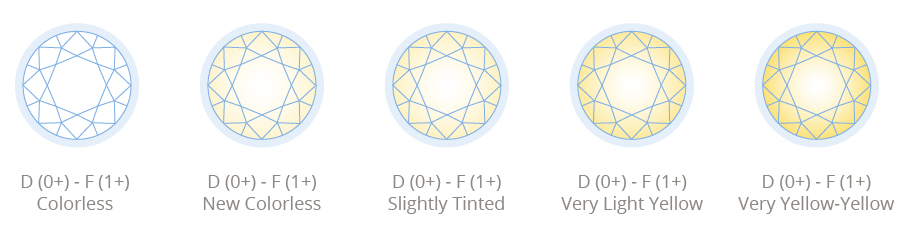
Perception of color
The amount of color you see in a cut diamond depends largely on its size, how it is cut, and whether or not it is mounted. The bigger the stone, the more obvious its color will be, just as a carafe of wine shows more color than a glassful.
Some people are more sensitive to the color of diamonds. What may appear slightly yellow to you may look white (lack of color) to another person, so it will take a higher color grade to satisfy you. The average shopper doesn’t even notice yellow tints in mounted diamonds having a grade from G to J because the increasing nuances of color are so slight.
What you see as the “color” of a diamond is really a combination of bodycolor, brilliance, and dispersion. Bodycolor is the inherent color of the stone and is caused by the different colors of light that are absorbed by the stone.
Brilliance is the total amount of light returned to the eye by reflections from within the stone and from its surface. This often is referred to as the “brightness” and “life” of the stone and determined largely by the cut of the diamond. The better the cut, the more light is reflected within the diamond and back through the top of the diamond.

Dispersion
Dispersion, or fire, is a spreading and separating of white light into its component hues, much like a prism. Even a colorless diamond will flash rainbow colors due to dispersion. Both brilliance and dispersion are desirable for beauty but are not measured or documented on any certification. Have a look at the figure on the right to see the illustration of dispersion (courtesy of IGI)
Keep in mind that color is graded with the diamond upside down in controlled lighting conditions. What you see looking a diamond face up is impacted more by the brilliance (cut of the diamond) than the color of the diamond. Color grading is not an exact science and even the certification laboratories will disagree about a diamond’s color grade. Remember, color grades are a range and at one point a high H is equal to a low G color. The distinction between color grades is so fine that sometimes the same stone will get different color grades if sent to the same grading laboratory a second time.
Color and price
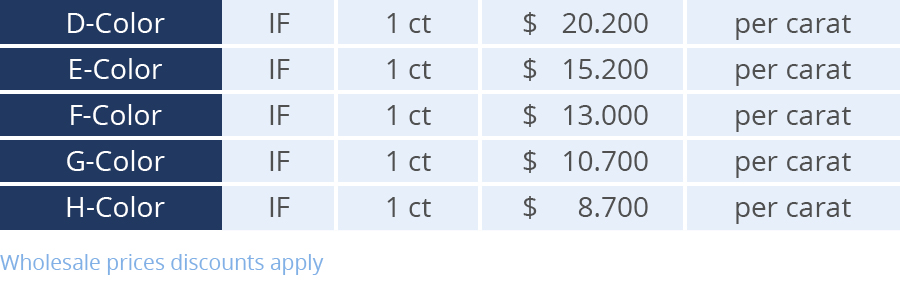
Prices for whiter color grades increase more dramatically than the actual visible color difference to the eye. Color grades D, E and F are colorless and it is very difficult to see the differences between these because by definition they are colorless. However, there is a significant price difference because D color diamonds are rarer than E and both are much rarer than F color. Please have a look at the figure below to see the difference in pricing when it comes color.
In the near colorless range (G, H, I and J), there is a more noticeable difference. While G color is very close to colorless, J color is very close to faint yellow. Most J color diamonds have a slight yellow tint. Diamonds with H and I color grade diamonds appear white and are great values because they are more plentiful than the colorless grades and therefore are less expensive.
To know what color grade you are comfortable with, go look at some diamonds side by side. Remember to be comparing HRD or IGI certified diamonds so you can be sure of the color you are actually seeing.
It is also helpful to be looking at similar sizes and shapes. Some shapes, like rounds, are brighter than others. Princess cut diamonds tend to be deep and darker looking than a round with the same color grade. Diamonds with greater carat weights tend to show more color than smaller diamonds with the same color grade.
Beware of the jeweler that tells you a higher clarity diamond makes it appear whiter. Clarity has no impact on color and this misinformation was meant to trick you into buying low color, high clarity stones they have in inventory and can not get rid of.